
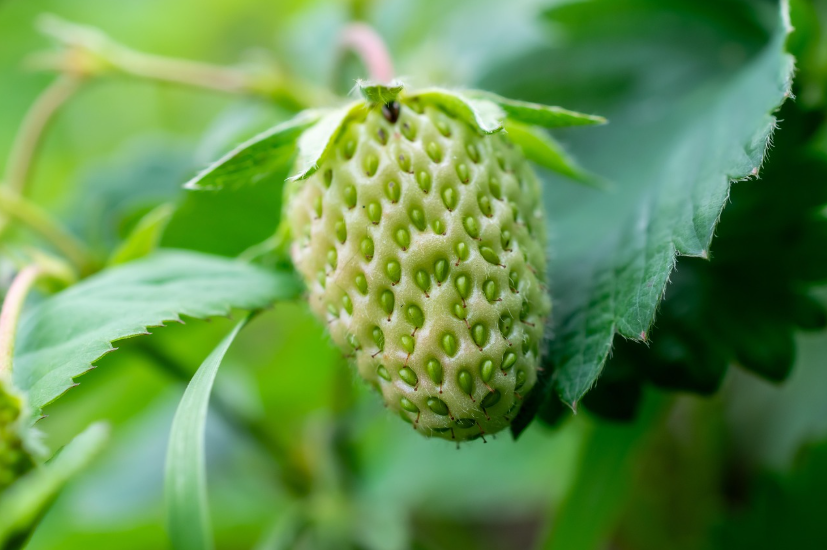
The second flowering of strawberries and satellite Earth observation – what do they have in common?
A press release by Blue Dot Solutions.
—
Earth Observation Forum, Gdańsk, November 5, 2026. In September and October, across the Pomeranian Voivodeship—with a particular focus on nearly 300 hectares of strawberry plantations in the Kashubia region (including the areas of Kożyczkowo and Borzestowo) — a rare and concerning phenomenon was observed: strawberry bushes blossomed for the second time this year, in some places even setting fruit. Satellite Earth observation data make it possible to precisely estimate the scale of this phenomenon, which, in the face of autumn weather anomalies, may negatively impact next year’s yields.
Satellite data are becoming a crucial tool for assessing the impact of secondary flowering on plantation condition and the upcoming harvest. The detailed analysis covered key cultivation areas in Kashubia. The study was based on a comparison of the 2025 and 2026 growing seasons using Growing Degree Days (GDD from the ERA5T reanalysis) and vegetation indices (Sentinel-2: NDVI).
Thermal Signal and Late-Summer Dynamics
The meteorological data analysis indicates that the autumn stimulation of strawberry vegetation was not driven by a higher cumulative heat sum across the entire summer season. For instance, the average GDD totals (for a 0 C base) for the third quarter (Q3) in 2025 and 2026 were comparable, at approximately 1,585.6 and 1,550.4, respectively. However, the specific distribution of temperatures at the end of summer and high dynamics at the turn of September and October proved decisive. While the entire month of September 2026 brought slightly lower temperature totals compared to the previous year (e.g., the mean GDD for the 0 C base was 443.5 versus 474.3 in 2025), the first decade of October 2026 was marked by a distinct warming trend. The average GDD total (base: 0 C) in the period of October 1–12, 2026 reached 157.3 (compared to 126.0 the year before), representing an increase of over 31 units. Prolonged warmth combined with moisture generated a strong metabolic impulse that disrupted the plants’ internal biological clock, triggering a “false spring.”
What is the NDVI Index?
- NDVI (Normalized Difference Vegetation Index) is a widely used indicator of general plant health that measures the amount of reflected light (the higher the value, the more lush and photosynthetically active the vegetation).
The Course of the Anomaly Through Satellite Eyes: A False Spring on Plantations
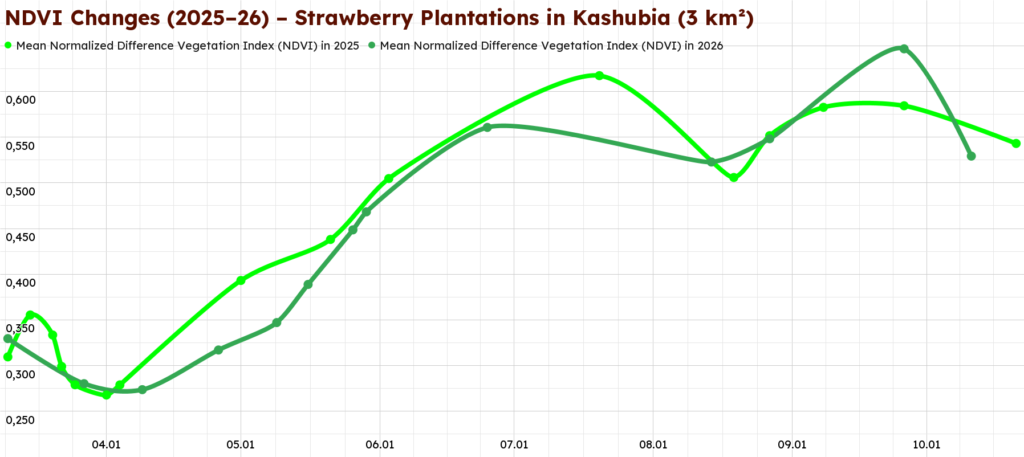
Remote sensing data from the European Sentinel-2 satellites precisely captured this process in numbers:
- Spring Awakening and Peak Vegetation (April–May): The 2026 season in Kashubia started with a slight delay compared to the previous year, as reflected by lower NDVI values at the turn of April and May (e.g., at the beginning of May, the mean NDVI stood at approx. 0.34–0.39 compared to higher levels around 0.44–0.46 in 2025).
- September–October Plot Twist (The Anomaly): In a normal vegetative cycle, the turn of September and October brings a natural decline in indices and prepares plants for winter dormancy. Meanwhile, during the analyzed period in 2026, the NDVI index on Kashubian strawberry plantations rose sharply—reaching 0.646 on September 26 and remaining at an elevated level (approx. 0.53–0.54) in the first days of October. This provides hard evidence that the leaves and tissues of the bushes maintained atypical, intense biological activity.
As a result, flowers and new fruit buds appeared on the plantations, drastically disrupting the plants’ natural dormancy cycle.
Outlook: Implications for the 2027 Harvest
Phenological anomalies carry serious economic risks. The development of flowers and fruit setting in autumn means that these organs will be destroyed upon the arrival of the first heavier frosts. Furthermore, the irreversible depletion of the plants’ energy reserves for an autumnal “false spring” directly forecasts the weakening of the bushes and the risk of reduced strawberry yields in the 2027 season.
The Gdańsk-based company Blue Dot Solutions specializes in the practical processing of satellite data for agriculture. Since 2026, the company has also been conducting analyses for orcharding and berry plantations based on optical and thermal data. This enables the monitoring of the condition of orchards and plantations as well as the early detection of anomalies that could affect the harvest.
More information: www.bluedotsolutions.eu
Data sources: ERA5T (ECMWF/Copernicus via meteoblue / Syngenta GDD tracking), Sentinel-2 (bands B4, B8).
Recent Comments